

Operation Black Buck 1 was a British air raid on the Falkland Islands, then occupied by Argentina. With a flight distance of more than 13,000 km, it was the longest-range air operation in history at that point.
To distract its own population from the problems at home, Argentina had launched an invasion of the Falklands in April 1982, betting that the British would not retake a few small islands thousands of miles from home.
The British, however, were planning both a ground invasion and bombing raids on Argentine airfields. The only aircraft considered capable of the job was the aging Avro Vulcan, which had originally been designed for medium-range nuclear strikes during the Cold War. By then it was at the end of its service life and barely flown anymore. On top of that, the Vulcan would have to be refueled in the air several times along the route, a dangerous procedure that had not been carried out in over 10 years. Several military scrapyards were searched for the missing parts. One of them turned up in the officers’ mess, converted into an ashtray.
Once the aircraft had been brought back up to standard, the crews had to relearn air-to-air refueling in record time, along with low-level precision bombing. The onboard computer that worked out the bomb release point still went back to Second World War designs and ran on screws and cogwheels.
After a rushed planning phase, two Vulcan bombers (one of them a spare) and 11 tankers took off from Ascension Island shortly before midnight on 30 April for the first mission. The tankers refueled each other every few hours, and each empty tanker turned back until only one Vulcan and one tanker were left. Because the mission had been thrown together in a hurry, the fuel consumption had been miscalculated: the Vulcan was 5 tonnes of fuel short for the return leg. Despite the risk of ditching in the open sea, the crew decided to press on with the attack. At an altitude of just 100 m, they slipped under the Argentine search radar and put a bomb on the Argentine airfield. With far too little fuel on board they turned for home and were topped up at the last minute by a tanker coming the other way. In total, 18 air-to-air refuelings were carried out during this mission.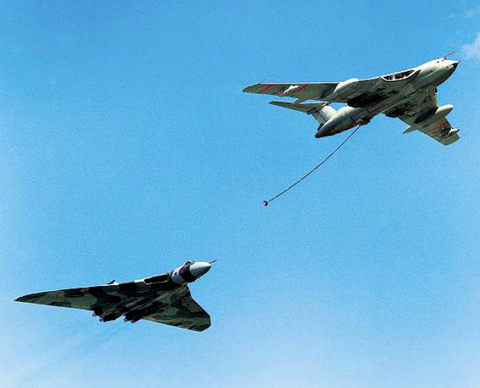
In tactical terms the damage to the airfield was minimal, but it showed the Argentines that the British could strike anywhere and at any time, however great the distance. Fearing air raids on their own mainland, the Argentine command also decided to move “Grupo 8”, the only group in the Argentine air force equipped with interceptors, further north, which played into the hands of the British landing on the Falklands.
Flt Lt Martin Withers, pilot of the Avro Vulcan that carried out the attack, was awarded the Distinguished Flying Cross, and his crew were mentioned by name in the final report. After this first mission, successful in spite of everything, six more Vulcan missions followed, some of them spectacular, and they kept the Argentines on their toes.
As so often in history, what made Black Buck 1 a success was not modern technology but good training, decisive action and the courage of the crew.
Author’s note: if you like our articles, you can support us with a purchase in our shop (click here). We’re grateful for every bit of support.


6 Comments
Michael Springl
@ Frank Nehler: Warum schämen Sie sich. Wir Deutschen brauchen uns inzwischen weder mit Langstreckenbombern abzugeben noch haben wir “Ländereien” auf der anderen Seite der Welt, die von anderen Nationen zurück beansprucht werden könnten. Im weiteren sind wir ein kleiner Baustein im Verbund der Nato, Entscheidungend dieser Art und auf Basis das Bündnisfalles fallen nicht in Berlin, sondern in Brüssel. Ich freue mich eher, daß wir diese Fahigkeiten nicht vorzuhalten brauchen und auch nicht haben.
Thomas Liebig
In Deutschland würde so eine Mission allein am fehlenden Gender-WC im Flugzeug scheitern.
D. Shughart
Anmerkung d. Autors:
Fehler mit dem “britischen” Radar wurde korrigiert. Danke fürs Aufmerksame lesen!
SIggi U
Ein Fehler im Text : hier wurde das argentinische Radar unterflogen!
Es war eine Meisterleistung der englische Streitkräfte bei der Landung und Eroberung der Falklandinseln
frank nehler
In Deutschland müssten dafür erstmal 20 Anträge, 10 Probeläufe und insgesamt 1 Jahr Wartezeit einkalkuliert werden. Armes Deutschland und eine Bundeswehr die zu bedauern ist. Ich schäme mich.
Bernd
Gut recherchiert, spannend geschrieben. Kann mich noch gut an die Zeit erinnern. Der Falkland-Krieg wurde damals in der Armee, die sich beim Vollzug der deutschen Einheit große Verdienste erworben hat, mit Interesse verfolgt. Heutzutage sind wir allerdings stärker geerdet, s. https://www.hamburg-by-rickshaw.de/ und interessieren uns auch für Klassische Musik, s. https://www.elb-plaza-philharmonie.guide/. Insofern teile ich die abschließende Bemerkung: “Wie so oft in der Geschichte führte bei Black Buck 1 nicht moderne Technik, sondern gute Ausbildung, entschlossenes Handeln und Mut der Besatzung zum Erfolg der Mission.” Abschließend ein kleine Korrektur: Es müsste m.E. das “argentinische” Suchradar gewesen sein, das in nur 100 m Flughöhe unterflogen wurde (s. viertletzter Absatz).
Leave a Comment